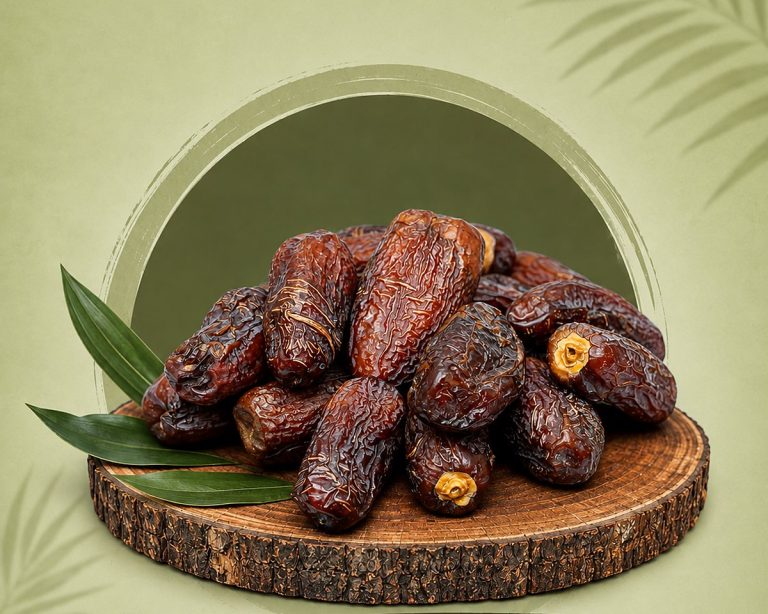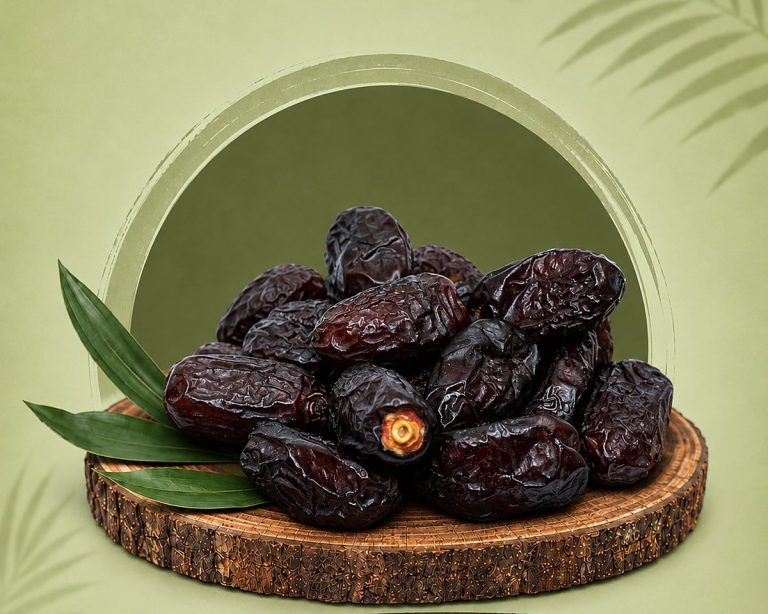

For Muslims around the world, dates on the iftar table are one of the sweetest signs of Ramadan. Breaking the fast with dates is a Sunnah of the Prophet ﷺ, and it is also one of the gentlest ways to bring energy back to the body after a long day of fasting.
The Sunnah of breaking the fast with dates
Anas ibn Malik (may Allah be pleased with him) described how the Prophet ﷺ broke his fast:
“The Messenger of Allah ﷺ used to break his fast with fresh dates before praying. If there were no fresh dates, then with dried dates, and if there were none, he would take a few sips of water.”
Sunan Abi Dawud and Jami’ at-Tirmidhi
On the morning of Eid al-Fitr, the Prophet ﷺ would also eat some dates before going out for the prayer, and he would eat them in an odd number (Sahih al-Bukhari).
Dates appear in the Qur’an too. When Maryam (peace be upon her) was in the pain of childbirth, she was told:
“And shake toward you the trunk of the palm tree; it will drop upon you ripe, fresh dates.”
Surah Maryam, 19:25
Why dates are a good way to break a fast
After a long day without food or water, the body needs something light that gives energy quickly without being heavy on the stomach. Dates are a natural fit:
- Their natural sugars give energy quickly.
- They contain fibre, which supports digestion.
- They are a source of potassium, a mineral the body needs after a long, hot day.
- They are soft and small, so they are easy to eat with a sip of water before the Maghrib prayer.
A few dates and water first, then the prayer, then the meal: a simple routine that keeps iftar from feeling too heavy.
How many dates does your family need for Ramadan?
Here is an easy way to estimate, so you do not run out halfway through the month:
- Decide how many dates each person eats at iftar. Three is a common choice.
- Multiply by the number of people at your table.
- Multiply by 30 days.
For example, a family of five eating three dates each needs 15 dates a day, or about 450 dates for the month.
How many dates make a kilo depends on the variety and the size of the harvest. As a rough guide, a kilo holds about 90 to 120 Ajwa or Safawi dates, but only 40 to 50 of the much larger Mejdool. Ambar sits in between.
So the same family of five would need around 4 to 5kg of Ajwa or Safawi for the month, or about 10kg of Mejdool. Add a little extra for guests, suhoor, and the iftar you send to neighbours and the mosque.
Ordering for Ramadan
- Order before Ramadan starts, so your dates arrive before the first iftar.
- Our 5kg packs suit most families. For larger families, mosques, offices and iftar drives, our Bulk Orders page has 10kg and 20kg options.
- Keep your stock fresh in the fridge or freezer. Our guide to storing dates explains how.
- For family and friends, an Eid box from our Gift Builder makes a thoughtful gift.
May Allah accept your fasts, prayers and good deeds this Ramadan.